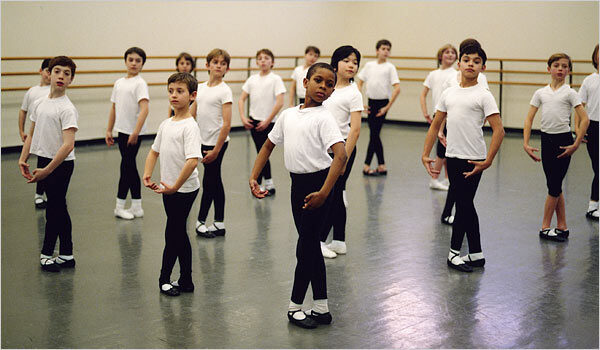
In a short documentary about boys at the Royal Ballet School in London, Sebastian Newsam explains why he chose ballet over ball: “Think how many people want to be footballers? Billions. And think how many boys want to be dancers? Which one are you going to take a chance at?” Training for male dancers, or danseurs as they are sometimes called, requires more weight training and conditioning on top of the regular technique and choreography. Since male dancers lift, throw, catch and carry their dance partners as they jump and run around the stage, upper body strength is as important as core and leg power.
Men are well represented at the highest ranks of American ballet, but more than half are foreign-born holding the highest positions of principals, soloists, ballet masters and resident choreographers. At the entry level, boys are a distinct minority. In most ballet schools, all-male classes were logistically impossible, an experience only available at intensive residential summer programs. Several schools have focused on broadening the enrollment of boys in their dance programs.
Peter Martins started the boys program at the School of American Ballet in 1992. In the prior 30 years, nine boys on average enrolled in the children’s division each year. He felt strongly that it was important to support their male dancers by recruiting enough boys to fill a class. Retired City Ballet principal, Jack Soto, said this of his first all-boy dance class: “Finally, I was with a bunch of guys and immediately it became quietly competitive. You saw what you were up against, and it made you thrive and work more.” That year the boys program enrolled 20 students. The program typically enrolls 50 students each year, 10-15 boys picked for their raw talent. The program accepts a larger proportion of boys, nearly half, than girl applicants, about one in five, as well as waives tuition for all boys older than 7 in the children’s division. While many younger boys’ classes are taught by acclaimed female teachers, the program prioritizes exposure to male instructors.
With the increase in dancing competitions on television, ballet has been highlighted for its foundational principles in all forms of dance and athleticism. In young boys, indicators of natural dancing ability include a sense of musicality, coordination, ankle flexibility, straight legs, hip movement, and particularly the ability to jump. To motivate boys to participate, avoid the term ‘ballet.’ Instead, talk about dance and movement. Bring in the competitive element: Who can jump the highest? Who can jump the farthest? And, remember many dance schools offer special prices for boys dance classes.
While Joffrey Ballet School’s children’s program offers weekly semester classes at $690, the Foundations of Ballet for Boys (ages 7-9) offers a special price of $100 per semester.
Likewise, at the School of American Ballet, girls classes range from $2900-$5860 a year, but the specially funded boys program provides free tuition for all boys enrolled in levels below Intermediate Men. The registration fee of $75 plus the annual student activity fee of $150 is still required. The Intermediate Men’s tuition for the year is $5,545, which is about $300 less than the Intermediate Girls classes. All Advanced classes for men and women are $5700.
The odds at producing international artists, just as in any sport, are slim. As Eliot Feld, who runs Ballet Tech, observes, “Attrition is great for both boys and girls. Unless you feel some calling from within, the training is more like physical punishment than study.” Despite the odds, 18 alumni dance professionally with companies around the United States, and three graduates dance with City Ballet: Amar Ramasar, a soloist; Ralph Ippolito, a corps member; and Cameron Dieck, an apprentice. That they can compete internationally with male dancers from South America, Europe and Russia is quite an accomplishment.